
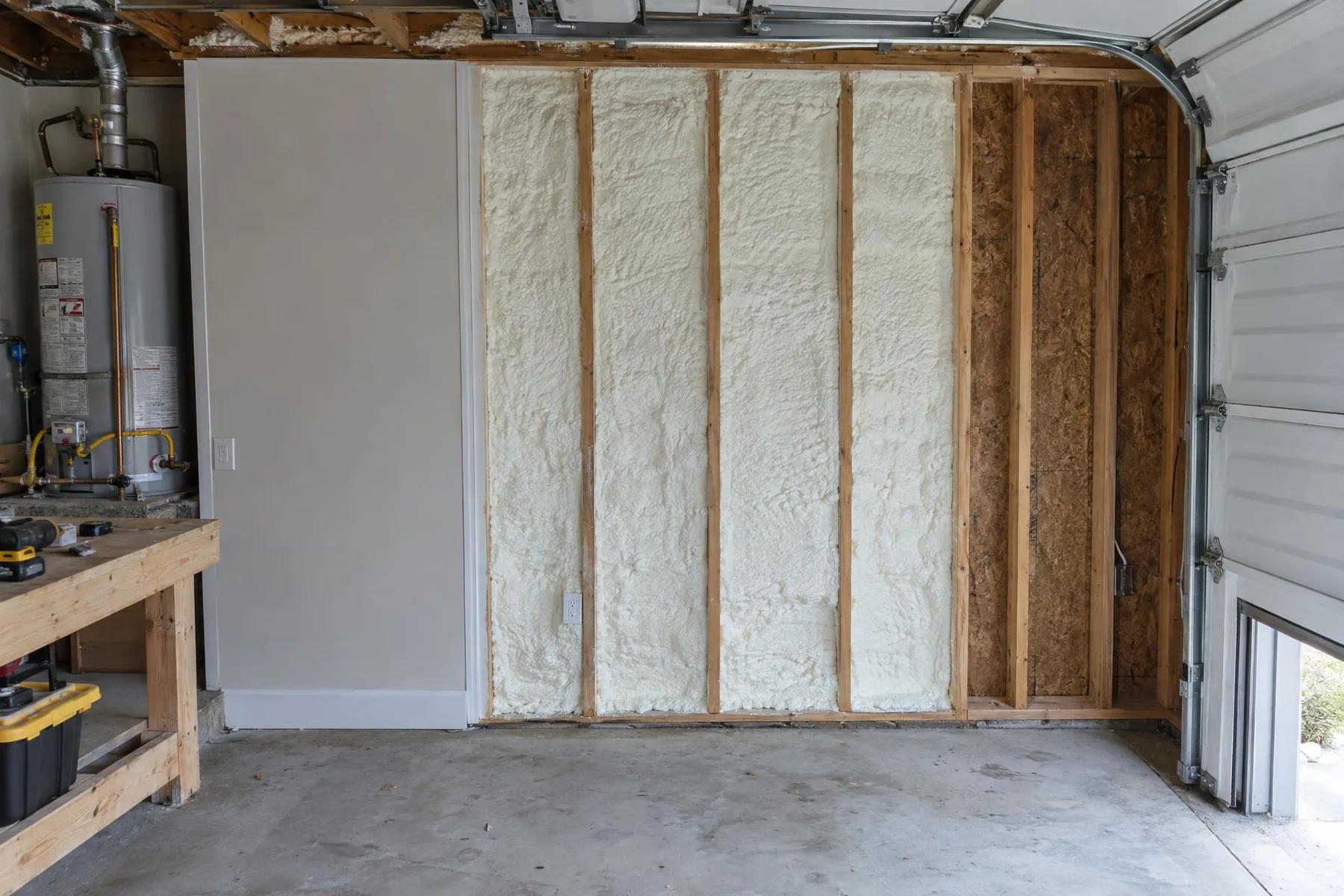
Garage wall with fresh spray foam filling the stud bays above a workbench, beside a water heater

Open Cell vs Closed Cell Spray Foam in Avondale, AZ: Open Cell Spray Foam and Closed Cell Spray Foam

Open Cell vs Closed Cell Spray Foam in Avondale, AZ: Which One Fits Which Surface

Avondale Spray Foam Insulation sets open cell vs closed cell spray foam side by side for Avondale and Maricopa County owners and builders, since the choice affects both cost and results. Open cell spray foam is cheaper and fills uneven cavities, whereas closed cell spray foam packs a higher R-value into thinner layers and belongs on the roof deck. Your needed spray foam r value depends on the surface, the space and your budget, and each surface on the estimate names its foam.

Why homeowners choose us:

  • Free written estimates for every insulation job
  • Open-cell and closed-cell foam matched to the surface, not one product for everything
  • Written warranty on every installation
  • Licensed and insured certificate on request

Our advice rests on 15+ years of foam and loose-fill experience, plus 1,000+ attics, walls and buildings completed. Because we spray both foams, the estimator picks what suits each surface and does not push whichever one is on the truck. A written warranty backs the installation, and the estimate costs nothing. Phone the office to compare both foams in your own attic.

Get a FREE Spray Foam Insulation Quote

Open Cell vs Closed Cell Spray Foam: R-Value and Cost for an Avondale Home

Each foam differs in R-value, price and the places it works best. Open-cell is rated R-3.5 to R-3.7 an inch, and closed-cell is rated R-5 to R-7 an inch. R-value per inch determines how deep a surface must be filled, and the table lists typical prices by surface with the foam choice noted.

Job Typical price Key variables
Spray foam, attic floor $1,100 to $6,800 open-cell for depth, closed-cell for tight access, thickness
Spray foam, attic rafters or roof deck $1,500 to $9,000 closed-cell on the deck, roof size, vents
Spray foam, existing walls $3,200 to $8,800 open-cell in deep cavities, wall area, siding
Spray foam, garage walls $2,600 to $8,900 foam type, wall height, garage size
Spray foam, whole house $4,000 to $26,000 mix of open-cell and closed-cell, surfaces covered

Where Open Cell Spray Foam Fits in an Avondale Home

Open cell spray foam is the less expensive of the two, rated R-3.5 to R-3.7 an inch. That makes it a solid choice for wall cavities and attic floors where a deeper layer fits. A deeper open-cell layer matches the R-value of a thinner closed-cell layer while using cheaper material, so budget frequently decides. In a deep cavity the added inches cost little and the savings are genuine.

As it cures, open cell also expands to fill odd gaps around framing, wiring and pipes, which explains its popularity in wall cavities. Projects on a budget often place open-cell in walls and on the attic floor, saving closed-cell for the roof deck so the extra money goes where it counts.

Inside an Avondale house, this foam works on new walls where the cavity is open and has depth. Finished walls leave less margin, so our crew checks access and cavity depth before suggesting it for a retrofit. For walls and garages see residential spray foam insulation, and for what each costs see the spray foam pricing guide.

Where Closed Cell Spray Foam Fits in an Avondale Home

Closed cell spray foam, the denser product, is rated R-5 to R-7 an inch and costs more. It is the stronger choice for roof deck work, where the layer is sprayed under the deck to form an unvented attic. Foam on the roof deck underside lasts around 30 years and puts the ducts within conditioned air.

Closed cell also suits cramped spaces, where a thin layer has to deliver a high R-value, and it is the recommended foam for roofs and walls on metal buildings. In other locations, properly installed polyurethane foam is good for 80 to 100 years. Neither foam goes down as one thick layer, since thin passes avoid shrinking and odors.

Direct summer sun hits the roof deck, so its foam carries the full roof load. Paying more for closed-cell buys extra R-value in each inch. In hot climates, roof deck work leans on closed-cell, where each inch of attic space matters and the load on the deck never eases. Where a rafter bay is too shallow for open-cell, closed-cell is how the target gets met. The estimator sets the thickness, and the crew measures it at several spots before leaving. Garage walls shared with a bedroom merit the same care, as garage heat reaches that room every summer afternoon, and either foam can be priced there for comparison. Attic work is covered on the attic spray foam insulation page, and metal buildings on the commercial spray foam insulation page.

Choosing Open Cell or Closed Cell Spray Foam for an Avondale Attic

Picking a foam for an Avondale attic means answering a few simple questions. Your estimator inspects the attic and works through them with you, and the result is a separate line on the written estimate. Every answer connects a surface to a budget and to the R-value required there.

How to Choose for an Avondale Attic

  • Roof deck work calls for closed-cell, the stronger option under the deck.
  • An attic floor with depth to spare suits open-cell, which reaches the target R-value for less.
  • A limited budget leans toward open-cell on walls and the floor, with blown-in for an attic that just needs more depth.
  • Shallow rafter bays that cannot hold open-cell depth need closed-cell, rated R-5 to R-7 an inch.
  • Ductwork in the attic calls for foam on the roof deck, because attic air can hit 130 degrees while the air in the ducts starts near 55.

What the Estimate Shows

Every line of the written estimate names the foam, the thickness and the R-value target. Mixed plans are common, with open-cell where depth exists and closed-cell where space is tight. Request both options priced for the same surface, then compare totals before deciding. The decision is yours. Our estimator explains each trade-off plainly, and no foam is sprayed until you approve the line in writing. With either foam, keep the sprayed area empty for 24 hours or more during curing, and the crew will say when the space is safe to use. Bring any bid you already hold, and the estimator will line up the foam type, thickness and price against it surface by surface.

Common Mixes in Avondale Homes

Garden Lakes era homes with attic ducts usually do better with closed-cell sprayed on the roof deck, which keeps the attic from being the hottest zone indoors. Walls in a finished home take open-cell if the siding permits access and the cavity has depth. A garage beside living space may take either foam, depending on depth and budget. The cheapest plan seldom performs best, so the estimate presents both options and lets you weigh the difference before any foam is ordered. Newer houses in Coldwater Ridge or Del Rio Ranch usually have more cavity depth than older ones, which tilts walls toward open-cell.

Open Cell vs Closed Cell Spray Foam FAQs: Avondale, AZ

What is the difference between open cell and closed cell spray foam?

Open-cell costs less and is rated R-3.5 to R-3.7 an inch. Closed-cell costs more and is rated R-5 to R-7 an inch. Closed-cell suits the roof deck, while open-cell fits cavities with depth to spare.

Which spray foam is better for an Avondale attic?

For roof deck work, closed-cell is stronger, forming an unvented attic that brings ducts into conditioned air. When depth exists and budget matters, open-cell works on an attic floor.

What is the spray foam r value per inch?

Open-cell is rated R-3.5 to R-3.7 an inch and closed-cell R-5 to R-7. Loose-fill cellulose, by comparison, is rated R-3.1 to R-3.8, with fiberglass at R-2.2 to R-2.9. The blown-in insulation page covers loose-fill.

Is open cell spray foam cheaper than closed cell?

Each project costs less with open-cell, though it offers less R-value an inch. A deeper open-cell layer can equal a thinner closed-cell layer in R-value, and the estimate prices both.

How long does each type of spray foam last?

Correctly installed polyurethane foam is good for 80 to 100 years. Roof-deck foam lasts around 30 years.

Can one house use both foams?

A single house can hold both foams, each on the surface that suits it. Every estimate line names the foam, so you can see which goes where. Open-cell on walls and the attic floor with closed-cell on the roof deck is a common plan.

Which foam is better for a garage wall?

Both foams can work in a garage wall, with wall depth and budget deciding. Open-cell is rated R-3.5 to R-3.7 an inch at lower cost, and closed-cell R-5 to R-7 an inch where space is limited. Our estimator measures the cavity and quotes both.

Does closed-cell foam cost more than open-cell?

Per project, closed-cell costs more because each inch carries more R-value. The added spend lets a thinner layer hit the same target, which helps in shallow rafter bays and under the roof deck.

Avondale Spray Foam Insulation serves Avondale and Maricopa County.

Get a Free Spray Foam Insulation Quote in Avondale, AZ

(623) 240-9099 Get a Free Quote